
Why should you upgrade to Drupal 9?

Are you familiar with the expression "if it ain't broke, don't fix it"? Well, it usually brings good results. Favouring stability over cutting-edge features is generally a good argument. Moreover, new versions can expose your CMS to new bugs, right? That said, why should you upgrade to Drupal 9?
Simple, because such arguments are not valid this time.
Why it’s a bad idea to keep using Drupal 8
You may be waiting to hear the usual arguments about why you should update to the latest version of Drupal. New features, increased speed, improved graphical interface, etc. However, that's not the case. Basically, Drupal 9 has the same features as Drupal 8, and its GUI has no noticeable changes. That being the case, why is it a bad idea to keep using Drupal 8 or even Drupal 7?
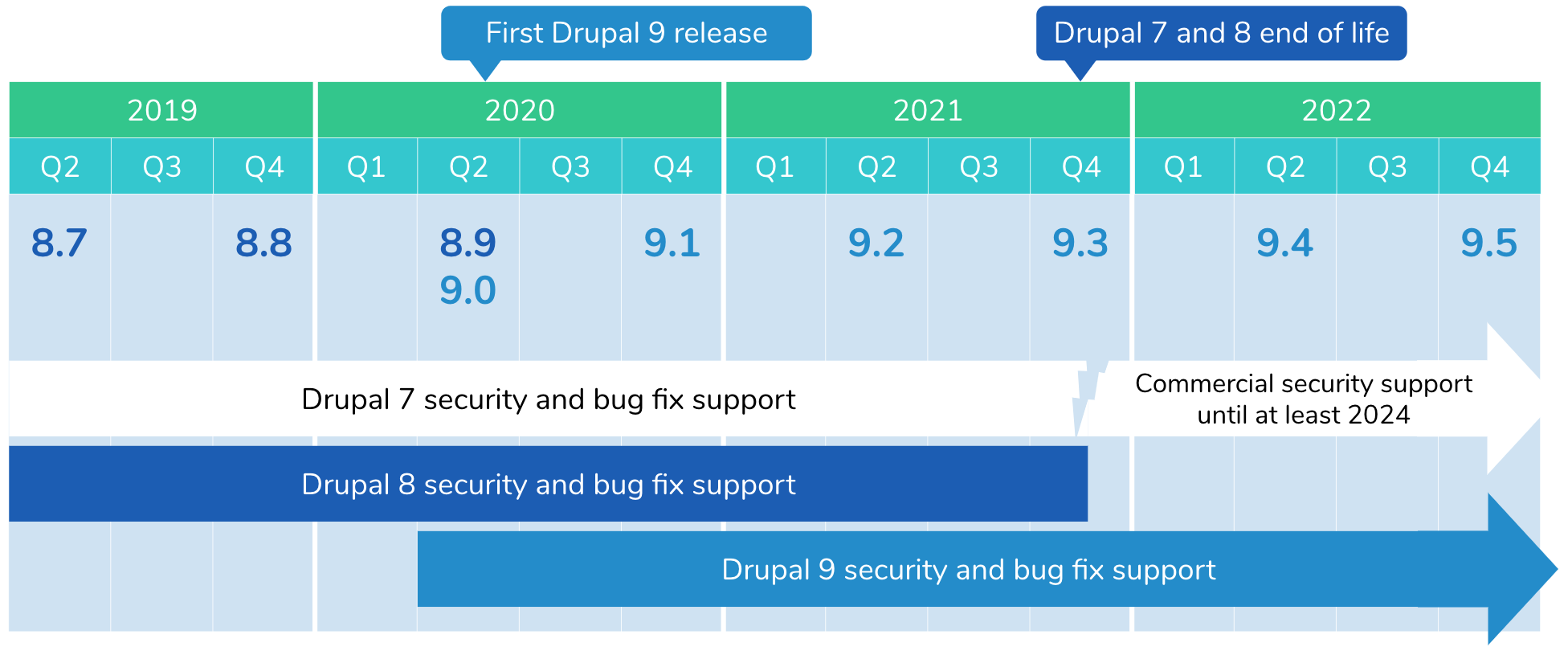
The answer has a lot to do with a great coincidence. Despite having independent development cycles, three End-of-Life (EOL) cycles have converged.
Drupal 8 EOL. Officially, Drupal 8 reached its end-of-life on November 2, 2021. For many administrators, this is reason enough to upgrade to Drupal 9 and continue receiving security patches to keep their site secure. It’s worth mentioning that although Drupal 7's EOL has been extended to November 2022, that doesn’t mean it is in a more favourable position as it will inevitably suffer from the same security risks as Drupal 8 very soon.
Symfony 3.4 EOL. Symfony 3, the open-source PHP framework on which Drupal 8 is built coincidentally also reached its EOL in November 2021. In fact, the end of bug fixes for Symfony 3 was in November 2020, making it even more urgent to update this robust framework.
PHP 7.3 EOL. As if the above wasn't bad enough, even PHP version 7.3 reached its EOL on December 6, 2021. While it is true that Drupal 9 is compatible with PHP 7.3 and 7.4, according to Drupal documentation, it’s highly recommended to start using PHP 8 as soon as possible. More on this shortly.
As you can see, it’s a perfect storm of life cycles coming to an end almost simultaneously. Unlike other occasions, it’s not only about Drupal but also about the fundamental pillars on which the CMS is built, Symfony and PHP. Can you imagine the number of vulnerabilities that this will bring in the near future?
Why you should upgrade to Drupal 9
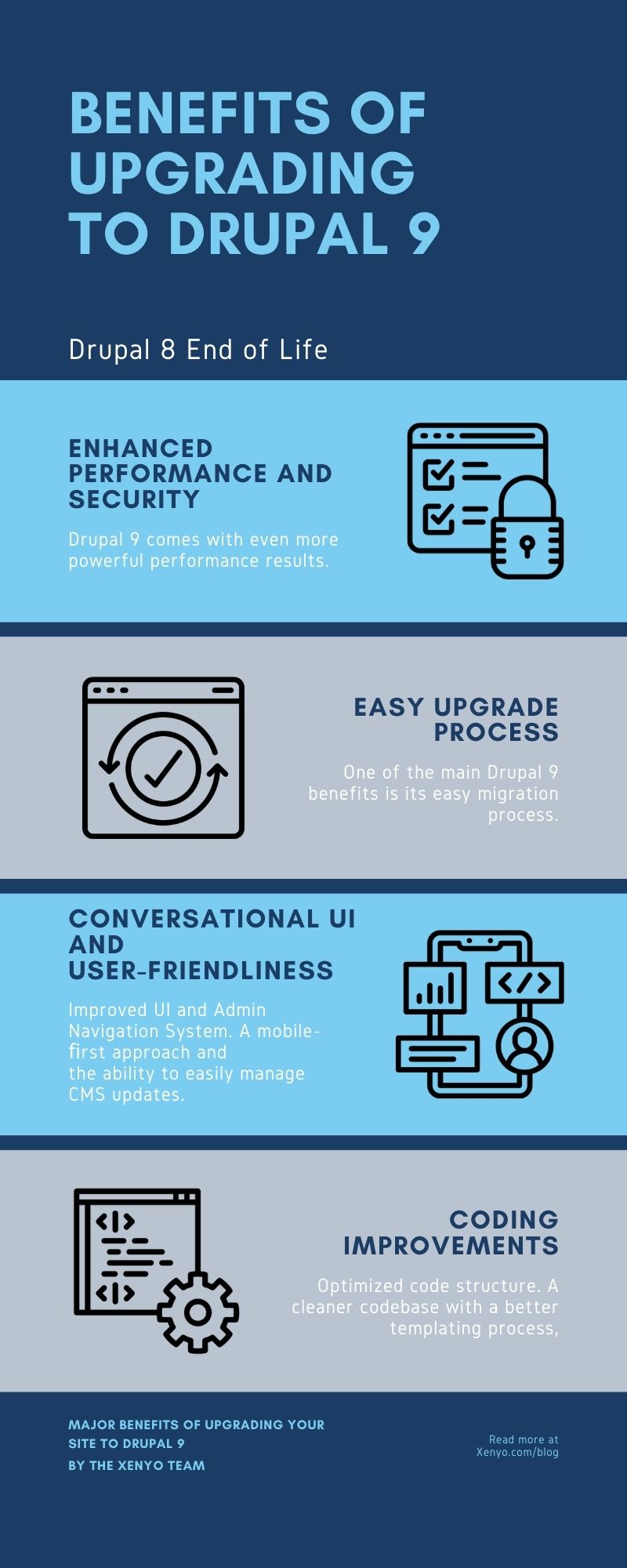
Given how critical it is to keep your website secure, there is no doubt that using Drupal 8 or 7 is no longer an option. The fantastic team behind Drupal knows this. For that reason, to cope with the confluence of end-of-life cycles, they decided to launch Drupal 9.
You can see Drupal 9 as an effective solution to the current situation, as it provides support for security fixes from November 2021 onwards. Furthermore, Drupal 9 has been developed to facilitate a smooth and easy transition for websites using older versions.
That explains why Drupal 9 has not focused on implementing new features but on being a turning point between the platform's past and future. To give you a better perspective of what we are talking about, according to W3Techs, version 7 is still used by 59% of websites, while version 8 is used by 23.1% of sites. Currently, only 13.8% of active sites are using version 9. In other words, more than 80% of websites using Drupal today should migrate to Drupal 9 to avoid facing a nightmare of security holes.
What to do now? What are your options?
If you are reading this, you are probably part of 80% of the admins using Drupal 7 or 8. So what are your options at this point? Ultimately, you must decide between three paths.
- Keep using Drupal 7/8. Your website won't stop working just because you don't upgrade to the latest version of Drupal. But don't be fooled; this is not an advantage. The temptation to "do nothing" can be costly in the short term. Keep in mind that you will have to upgrade Drupal and its dependencies sooner or later. For this reason, it’s preferable to do such a migration with proper planning rather than being forced to upgrade after your site has been compromised.
- Upgrade to Drupal 9. This is the option suggested by our experts. The process will be easier if you are using Drupal 8.8 or 8.9. For Drupal 7 users, it is also possible to upgrade, but it will be a bit more complex. This is because regardless of your version, you will need to update all your modules and themes to remove deprecated code before starting the upgrade to version 9. This is exactly what has stopped many administrators from installing newer versions. However, the time has come to do so.
- Wait for the release of version 10. Drupal 10 is expected to be a milestone in terms of features and security. Among many enhancements, version 10 will offer support for Symphony 5.4, CKEditor 5, replace jQuery with JavaScript elements, plus the long-awaited automatic updates. So, why not wait for this version? The problem lies in the uncertainty of when this version will finally be available. According to the documentation, there are three scenarios, the first one where Drupal 10 will be released in June 2022, the second one where it will be released in August 2022, and the third one where Drupal 10 will be released on December 14, 2022. Part of the idea behind Drupal 9 was to give users peace of mind and, at the same time, provide the development team time to complete all the features. Again, there are many dependency changes on multiple fronts, making this release a time-consuming endeavour.
Final thoughts
Do you still have doubts about the best course of action? You are not alone. Although Drupal 9 was designed to offer an easy and convenient upgrade path, the process can be challenging, especially if your site uses custom themes or plugins.
If that's the case, nothing better than seeking expert support. At Xenyo, we offer integral solutions for Drupal. From web design and application development to customisations that allow you to get the most out of Drupal CMS. Moreover, as leaders in Drupal technical solutions, we are familiar with the specific needs of organisations of all types, from small startups to enterprises. Contact us today to learn more about how we can help you during this transition.